
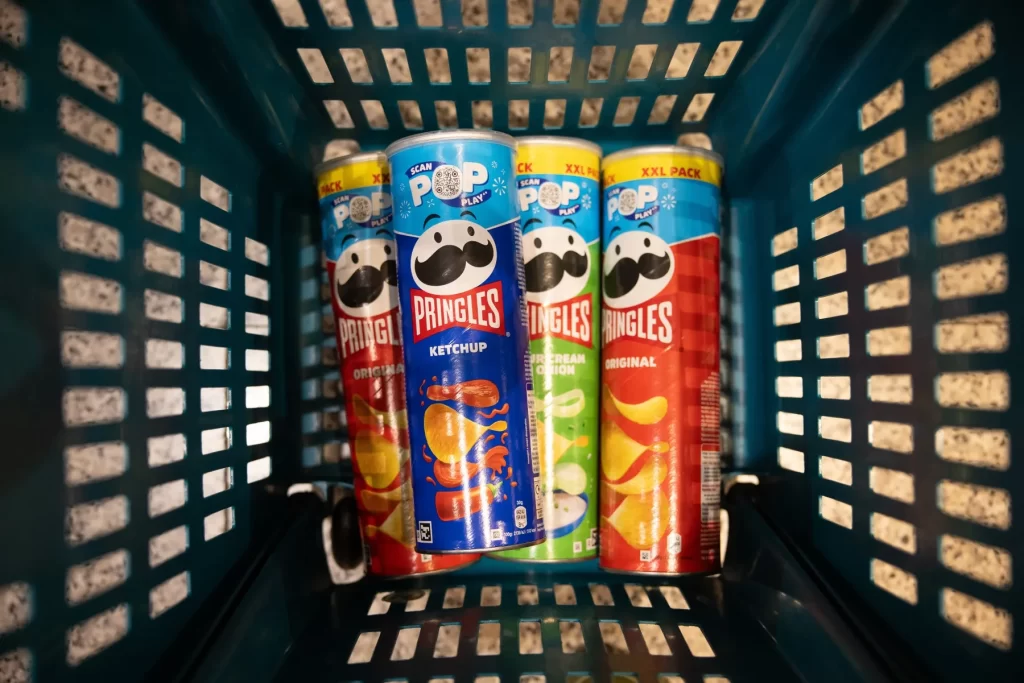
Packages of Pringles chips, manufactured by Kellanova. Photographer: Andrey Rudakov/Bloomberg
Mars Inc.’s $36 billion bid for Pringles chips maker Kellanova faces a potential glitch after European Union opened an in-depth investigation over concerns the largest packaged-food deal in almost a decade could thwart competition.
The deal will give Mars “several very popular brands of potato chips and cereals to its already broad and strong product portfolio,” the EU’s antitrust chief Teresa Ribera said in a statement. The probe “will assess the transaction’s impact on the price of these companies’ products for consumers.”
Watchdogs will examine how Mars might increase its bargaining power in discussions with retailers if it absorbs Kellanova’s product line and how this might lead to higher prices at the checkout. Regulators set an initial deadline of Oct. 31 to decide whether to approve the all-cash transaction or block it.
Both Mars and Kellanova said that they are “optimistic” that they will ultimately receive approval for the deal. Shares of Kellanova fell 0.7% at 1:35 p.m. in New York.
The investigation comes as EU competition enforcement heats up across the consumer-goods markets. Just last year, Oreo-maker Mondelez International Inc. was fined €337.5 million ($393 million) for allegedly thwarting cross-border sales of its chocolate, cookies and coffee. More recently, EU regulators have dug into global firms such as Coca-Cola Co. and Pampers diapers maker Procter & Gamble Co. over similar concerns.
Buying Kellanova will help closely held Mars diversify its chocolate-heavy portfolio away from cocoa, whose prices have risen to historic levels. Kellanova itself has fared better than most of its competitors with a string of strong earnings since it spun off its cereal business as WK Kellogg Co.
Since 2020, McLean, Virginia-based Mars has bought brands like Hotel Chocolat, Tru Fru and snack bar maker Kind’s North America business. The company’s last major deal was in 2017 when it bought veterinary hospital operator VCA Inc. for about $9 billion.
The EU’s in-depth probe into Mars marks Ribera’s second full-scale EU merger investigation since entering office last year, following a probe into Formula 1 owner Liberty Media Corp.’s $3.8 billion motorcycle racing league MotoGP World Championship. That deal was unconditionally cleared on June 23.
So-called phase 2 probes add about 90 working days to EU deal reviews. Regulators typically demand remedies to solve competition concerns but sometimes also decide to give their unconditional approval if initial concerns are shown to be unfounded.
Separately, the Federal Trade Commission announced Wednesday evening that it had ended its review of the proposed deal after nearly a year of investigation, concluding that the deal was not anticompetitive.
“Commission staff closely reviewed every aspect of this transaction, including both specific product markets and potential portfolio effects from the acquisition,” Daniel Guarnera, the FTC’s director of the Bureau of Competition, said in a statement. “Staff found that the evidence pointed in one direction: This transaction does not meet the standard for an anticompetitive merger.”
Source : bloomberg.com
 English
  Français