
Photo by gyn9038/iStock via Getty Images
Where would Batman be without Robin? With that logic, you can say that where would Lithium be without Cobalt in most electric cars?
Electric vehicles are moving on in and this impacts the materials that compose their electric batteries. One of the materials used can be cobalt (depending on the battery). Rather than have all my EV bets on lithium, it is wise to spread out money into related materials. In this article, we will look at the various catalysts that impact lithium and cobalt. Then we will focus on our main cobalt play, First Cobalt (OTCQX:FTSSF) & (TSX.V:FCC), and how we are taking advantage of the EV sea change.
Craigs' Lithium-Cobalt Catalyst Tracker
- Volkswagen (OTCPK:VWAGY) will spend $86 billion on electric cars
- BMW (OTCPK:BMWYY) $32 Billion
- Ford (F) $22 billion by 2025 and they are expanding EV capabilities.
- CATL will spend $5.1 billion to build a battery plant
- General Motors (GM) via a $2.2 billion investment into electric vehicles at Detroit
- GM $2.0 billion, TN (plus an additional $153 billion for upgrades) and that is just part of the $20 billion they plan on investing over the next 5 years
- Toyota Motor Corp. (TM) $2 billion spent by 2023
- Porsche (OTCPK:POAHY) $678 million
- Even Harley-Davidson (HOG) is getting into the mix
- Bentley is entering the EV market by 2025 and 100% electric by 2030
- Archer (an electric plane company) is set to enter the market via a SPAC soon with an estimated $500 million in funding.
- Northvolt $600 million
- Fisker (NYSE:FSR) leaves solid-state batteries to focus on conventional lithium $1 billion
- Rumors circulate that GM might build a 2nd battery plant via the WSJ.
- Volvo (OTCPK:VOLAF) to ditch ICE engines and go 100% electric by 2030.
- Ultium to build 30GW factory by mid-2022.
- Tesla (TSLA) continues to build out its Austin, TX $1.1 billion Gigafactory.
- Tesla’s Gigafactory in Germany is moving forward with a subject to slippage launch date of this summer.
- Livent (NYSE:LTHM) signs $335 million supply deal with BMW.
- An electric Silverado is in the works.
- Tsingshan Holding Group to invest $1.57 billion in lithium-ion battery plant,
- South Korea’s LG to invest $4.5 billion in its US battery business.
- EVLOMO & Rojan to invest $1.06 billion for an 8 Gwh plant in Thailand.
- Orocobre (OTCPK:OROCF) and Galaxy Resources (OTCPK:GALXF) will merge.
- Vistra (NYSE:VST) opens 1.2 Gwh plant in California with expansions.
- Ford to open a battery research lab.
Now thinking about all of the above demand for a moment, one must realize that cobalt will factor into this. Where does one get cobalt and who presently controls it?
He Who Controls the Spice Cobalt, Controls the Universe
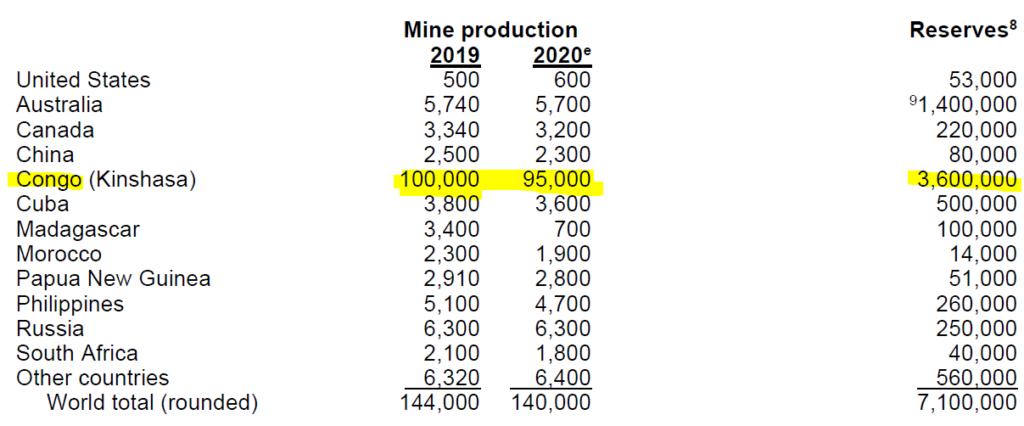
Let’s look at cobalt worldwide supply while simultaneously contemplating world geopolitics and logistics. Long distances increase the cost of transporting cobalt. Concerning geopolitics, a disruption to any nation’s cobalt supply could have far-reaching implications from a strategic standpoint. Having a domestic supply favors economic independence. Supply per the USGS:
(Source: USGS)
Per the USGS (US Geological Survey), the Congo supplies 70% of the world’s cobalt. China, one of the leading consumers of cobalt, uses 80% of its cobalt for rechargeable batteries. The Congo is not exactly a region known for its stability. Any disruption to the Congo’s 70% supply of worldwide cobalt could result in massive price spikes for the metal. This is undesirable.
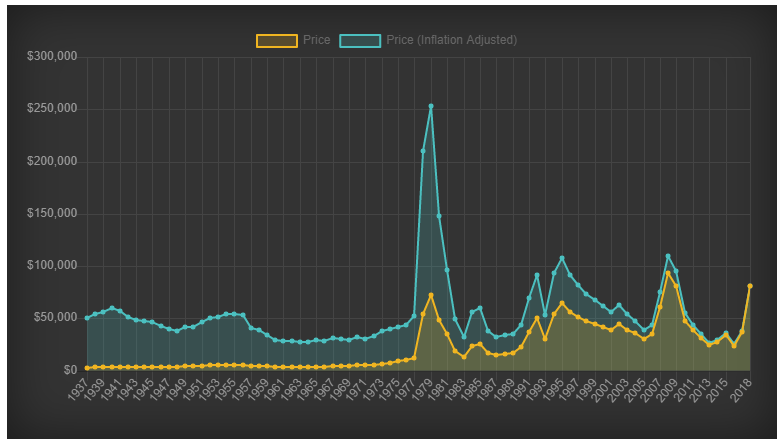
Alternative sources need to be found in preparation for the EV car revolution in the works. Per Metalary.com, we can see a chart stretching back to 1937 for cobalt prices. We can see cobalt spike during the 2018 lithium spike and the recent 2021 lithium price recovery.
(Source: Metalary)
Looking at demand estimations: First Cobalt puts 85% of the worlds EV batteries to contain cobalt by 2030.

(Source: First Cobalt via Global Industry Analysts)
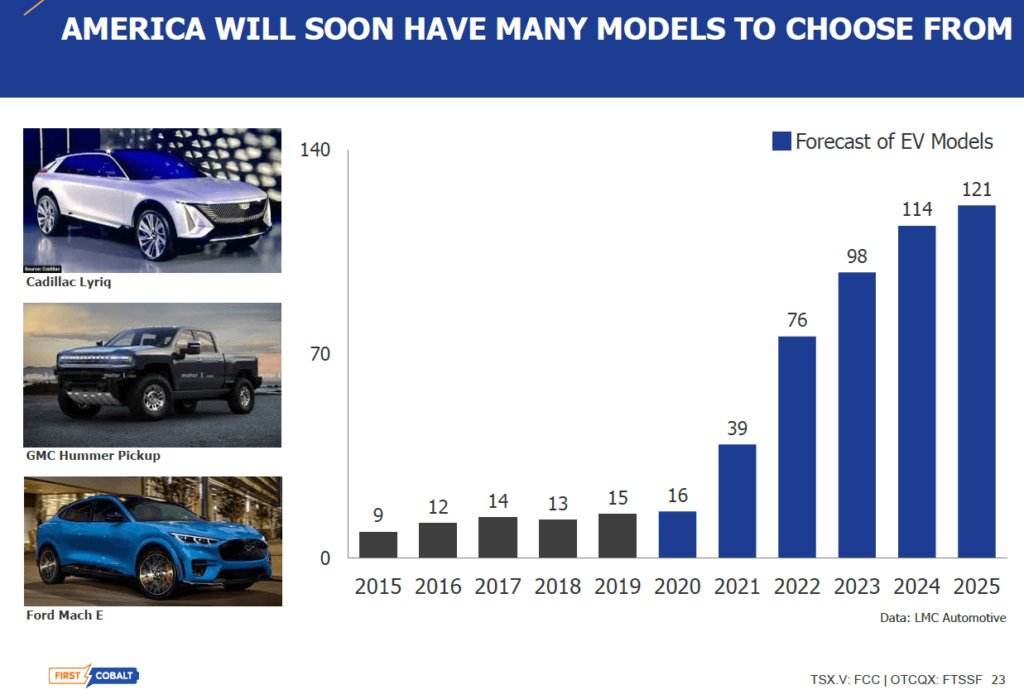
Also, the spectrum of EV choices is expected to expand that will give consumers many more choices (which will create additional cobalt demand).
(Source: First Cobalt)

(Source: First Cobalt Market Intelligence)We can also look at other sources for the estimated cobalt demand such as Cobalt Blue (OTCPK:CBBHF) via UBS Bank.
(Source: Cobalt Blue page 8 via UBS Bank)
Geopolitics of Cobalt
Looking at the below map, we see that cobalt flows from the Congo to China for processing (and to a limited extent Finland). First Cobalt aims to siphon off some cobalt processing to North America. For a larger picture, use the link in the source below and go to page 14. The blue dots represent Lithium-ion battery cell plants in North America and Europe. Orange are “other refineries”. Bringing processing to North America helps ensure domestic supply of refined cobalt. Eventually, First Cobalt’s domestic supply of cobalt will come online via its cobalt mines. At that point, North America will be in a much better strategic position.
It should be noted that Jervois Mining (OTCQB:JRVMF) also has cobalt property in Idaho and is working on a cobalt refinery in Brazil.
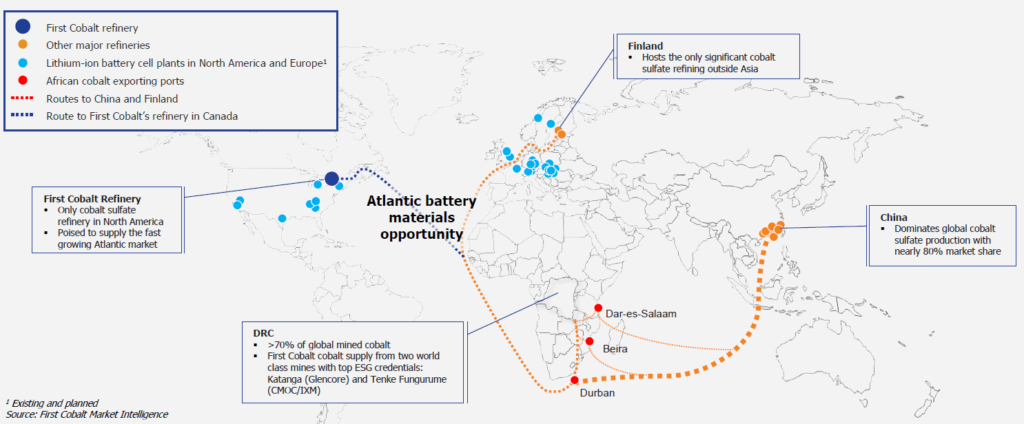
(Source: First Cobalt)
First Cobalt, A Future Cobalt Leader
Given all of the above demand (with potential price geopolitical constraints), points us to North America needing cobalt flexibility from a strategic geopolitical viewpoint and the viewpoint of needing additional cobalt for EV batteries. Thus, our investment pick for this article is a company out of Canada called First Cobalt. Before we continue, we acknowledge First Cobalt is a small company with limited capital resources. The company will need additional funding to realize its cobalt dreams, but it is making progress via debt financing:
An exclusivity agreement with a leading financial institution (the “Lender”) for US$45 million in debt financing to fund the capital cost relating to the recommissioning and expansion of the First Cobalt Refinery. The exclusivity period provides the basis for which the Lender will complete its remaining due diligence requirements prior to the negotiation of definitive documentations.
The financing process, which is being led by CIBC Capital Markets, is expected to be completed prior to announcement of a formal construction decision. In December 2020, the Government of Canada and the Government of Ontario announced a joint $10 million investment in the First Cobalt Refinery to help accelerate commissioning and expansion.
Permitting remains on schedule, supporting a commencement of construction in mid-2021. The Company’s strong treasury has supported pre-construction activities, including procurement activities for long lead equipment orders.
Trent Mell, President & Chief Executive Officer, commented:
We are on track to achieving our goal of commencing construction in mid-2021 and full commissioning in the second half of 2022. Progression into an exclusivity phase for a debt facility without a royalty or stream represents a key milestone in securing the remaining capital needed to restart the First Cobalt Refinery and brings us one step closer to our vision of producing the world’s most sustainable cobalt.
The Focus of First Cobalt
First Cobalt has four main areas of focus:
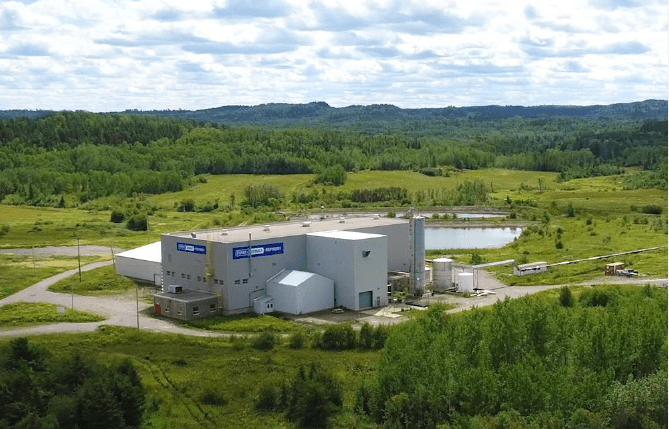
1. Reopening a cobalt refinery (pictured below) by October 2022. More updated news from the 28th of April is that the company has been awarded $600k dollars by the Department of Energy to explore its cobalt refining technology.
(Source: First Cobalt)
2. Researching “black mass” recycling at the cobalt refinery. Black mass is slang for the various components that arrive in a lithium battery. This might include plastic and various metals to include lithium, cobalt, copper, etc. The company is exploring how to process these and become a recycling powerhouse in addition to refining and mining cobalt.
3. Exploring the flagship Iron Creek Project for cobalt mining. From company slides, we are looking at a feasibility study in 2023. Thus this one is going to take a few years to potentially pan out or move forward.
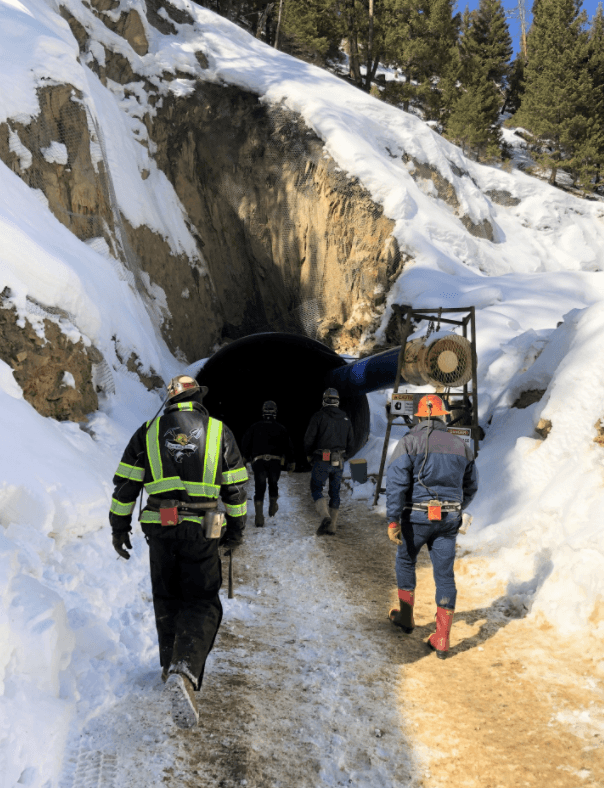
(Source: First Cobalt via the Iron Creek mine)
4. A partnership exists with Kuya Silver (OTCQB:KUYAF) to push the “Cobalt Camp” mine in Ontario, Canada. One interesting side point is that copper and silver exist at the mines and this might yield valuable materials as an unexpected bonus.
Conclusion
First Cobalt is a risky junior miner with a market cap of just $136 million in USD. While we assess from a geopolitical and market demand standpoint they will be a success, this does not mean reality will concur. Unexpected things can and will occur. At the same time, the Biden administration is going all out to push EV. This bodes well for cobalt and lithium stocks.
One point to note is that cobalt use per car is going down. Overall demand for the EV cars is going up. So we should see a situation where overall demand rises for cobalt. While the majority of my bets are on lithium, it may not be a bad idea to place a few small side bets on cobalt. Please do your own due diligence before gambling on junior miners. Additional financial data to include offtake agreements, capital structure, and financial deals can be found via the April 15, 2021 PDF.
Disclosure: I am/we are long FTSSF, LAC, JRVMF. I wrote this article myself, and it expresses my own opinions. I am not receiving compensation for it (other than from Seeking Alpha). I have no business relationship with any company whose stock is mentioned in this article.
Additional disclosure: We own long calls in LAC.
We have sold puts in LAC for June at a $12.50 strike.
Source : seekingalpha.com
 Français
  English
Very efficiently written post. It will be useful to anybody who employess it, including me. Keep up the good work – i will definitely read more posts.